From 2007 onwards, Anatomical Concepts was Hasomed's UK distributor, and a great deal of what we know about FES cycling in clinical practice was gained with the generations of RehaMove systems. Eighteen years is a long time to spend with one platform. You learn its habits and positives, you learn its quirks, and you build a clinical workflow around it that becomes second nature.
So when Hasomed announced they would stop placing the RehaMove on the European market at the end of 2023, we were looking for an alternative. FES and FES Cycling are very important to us and we were anxious to identify a great replacement.
We are now offering the Stim2go from Pajunk as a direct replacement for the RehaMove in our UK FES cycling offering. Anyone who used the RehaMove for years, as we did, will have the same instinctive worry: that years of accumulated competence are about to be reset. However, most of the fundamentals that you know carry over. Some of it needs recalibrating. A small amount is genuinely new. The point of this article is to clarify which is which.
What the RehaMove Did Well, and Why You Got Good at Using It
The RehaMove, in its different generations, did one thing very well, and the clinical community got good at using it because of that. It synchronised stimulation to a known pedal angle, read off the bike directly, and let the therapist set up programmes in clear bilateral channels. Up to eight channels meant you could drive for example, quadriceps, hamstrings, gluteals and calves on both sides without having to choose. The interface consisted of a screen, buttons, and a knob, so most users could understand how to use it. The bike was one of the limited range of MOTOmed bikes that happened to offer a serial interface for connecting the stimulator. Once your electrode placement was good and your programmes were saved, you ran sessions on autopilot.
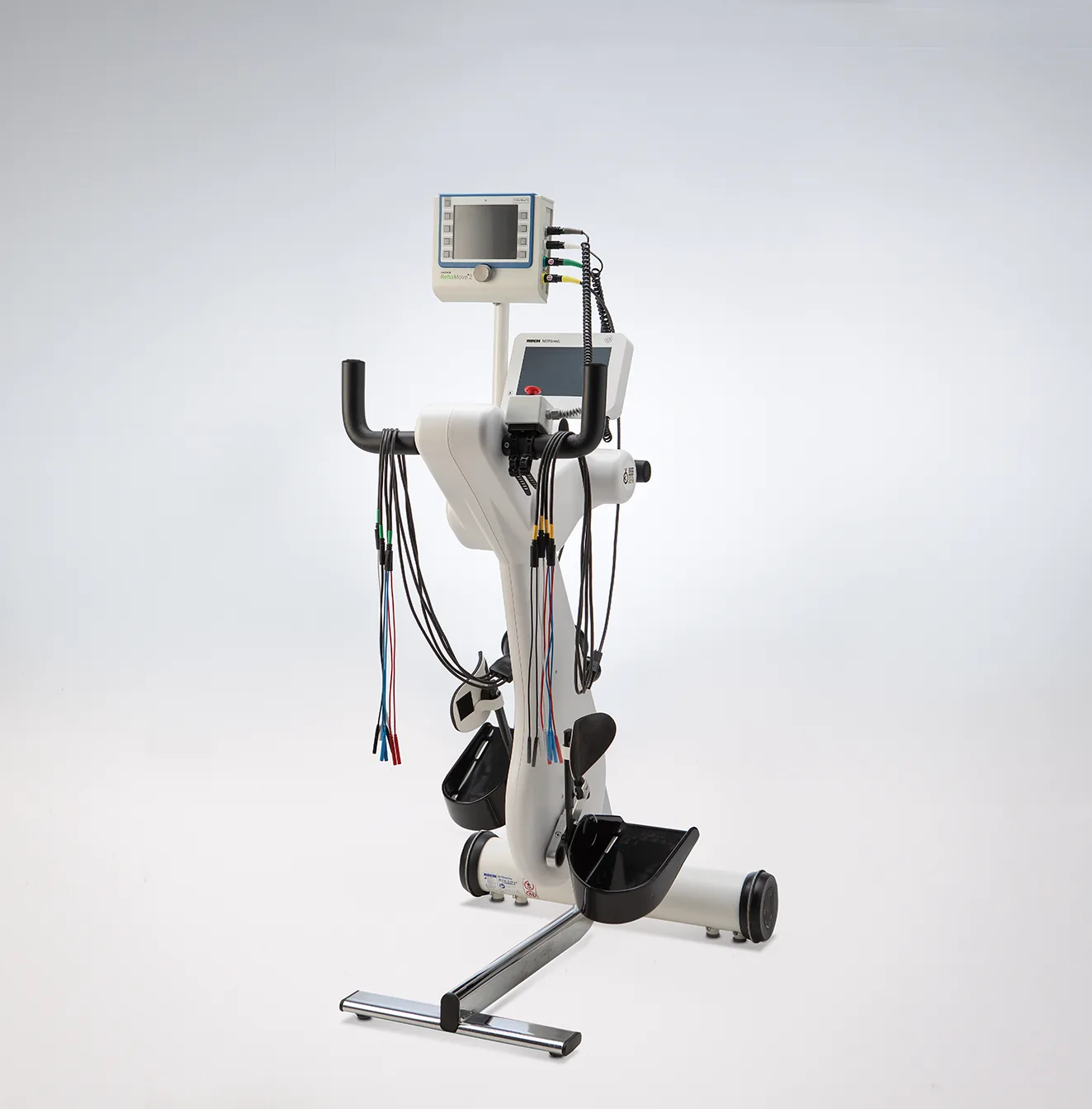
That accumulated competence has a real value. It is not equipment-specific. The skill of placing electrodes, reading muscle responses, judging fatigue, sensibly ramping stimulation parameters, screening for contraindications, and adjusting expectations is a clinical skill, not a brand skill. None of that is obsolete.
The RehaMove 2 also had a great ability to be used without the bike. By using Sequence Mode, it was possible to create quite complex stimulation sequences to support NMES-augmented exercises. Not all clients used this, but it was one of the most powerful features. As we will see, one of the strengths of Stim2Go is its versatility across many applications, not just FES Cycling.
What Carries Across to the Stim2Go
This is the bit I want to lead with, because it is what most physios I speak to need to hear first.
The underlying physiology is unchanged. For FES Cycling, you are still using surface electrical stimulation to recruit innervated peripheral motor nerves and to produce muscle contractions synchronised with the cycling motion. Recruitment order, fatigue behaviour, threshold characteristics and tolerance build-up are the same. You can control the key stimulation parameters: frequency, pulse width, and current.
Electrode placement is the same. Quadriceps, hamstrings, gluteals, gastrocnemius, tibialis anterior, plus the upper-limb sites for grasp and reach work. Skin preparation, hair management, electrode care and replacement intervals (typically fifteen to twenty sessions for self-adhesive pads) carry over without change.
The contraindications are much the same. Active deep vein thrombosis, certain implanted devices without specialist clearance, fresh skin breaks in the stimulation field, unstable autonomic dysreflexia, malignancy in the field of stimulation, and pregnancy.
The programme structure is much the same. Warm-up, build-up, working phase, cool-down. Three to five sessions per week. Twenty to forty-five minutes of effective work. Progression by current, by resistance, by duration. Long-term commitment over months and years for the secondary health benefits to accumulate.
The four pillars of a worthwhile FES cycling programme that I wrote about recently, a proper pre-purchase assessment, a structured starting protocol, genuine support after the sale, and a long-term plan, do not change with the equipment.
So when a colleague asks me whether they need to retrain, the honest answer is no. Not really. They need to recalibrate, which is a different thing.
What Is Genuinely Different in Day-to-Day Use
Three things change in week one with the Stim2Go, and they are worth setting out clearly.
The synchronisation source. RehaMove reads the pedal angle from the MOTOmed bike via a communication cable. Stim2Go does not 'read the bike' at all directly. Instead, the stimulator is a single 185-gram body-worn unit that straps to the right thigh and contains a 3D accelerometer and gyroscope sensitive to movement speed and direction.
It learns the pedal cycle from leg motion and triggers each muscle channel at its programmed point in the stroke. The practical implication is significant: the stimulator does not care which ergometer is in front of it. A clinic with an existing MOTOmed estate, a Thera-Trainer Tigo, or another active-passive cycle can pair Stim2go with what is already in place. The bike becomes interchangeable.
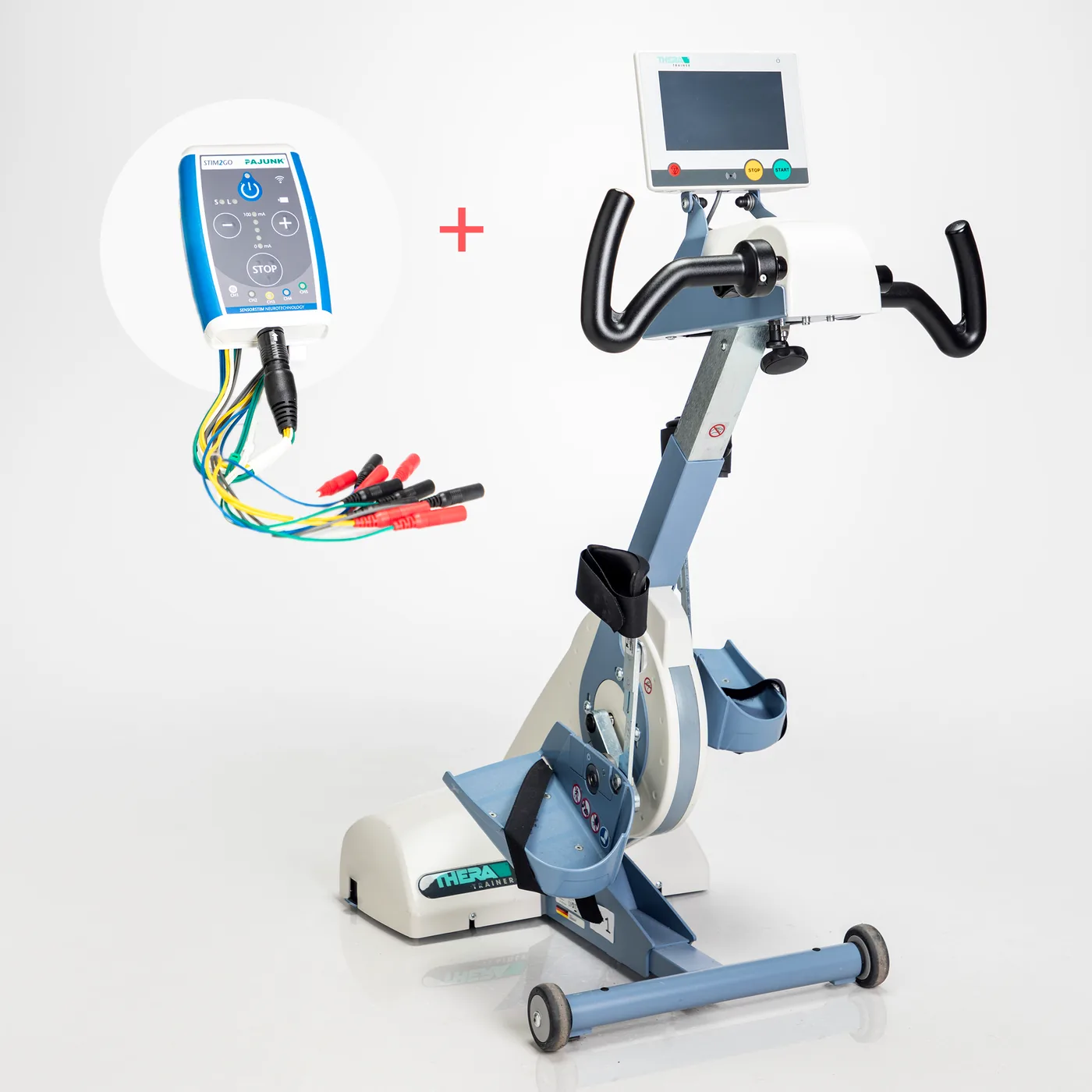
Basically, any passive-active bike can become an FES bike.
This is the single most useful architectural change for anyone running an existing FES service. You no longer have to replace a working bike to create an FES Cycling system.
User types. The Stim2Go comes with around 30 predefined programme templates that you can use as they are, or select one and modify it to create a custom programme. There are two types of accounts: therapist and patient. A therapist can create custom programmes and easily modify any stimulation parameters. If you're logged in as a patient, you can only change current intensity but not make fundamental changes to the programmes. We generally create custom versions of programmes for clients and can even assign new programmes to them 'at a distance' so they appear in a user's account ready for use.
The channel count. The RehaMove2 and RehaMove3 generations supported up to eight stimulation channels. Stim2go has five. Some may feel this is not enough and certainly we always liked to have eight in the past. However, it is not automatically the case that more channels is better. More channels mean longer setup times, more electrodes, and more cable issues.
For most bilateral lower-limb cycling protocols, five channels are workable: quadriceps, hamstrings, gluteals and calves on both sides were a luxury most clinicians did not always use, and four muscle groups bilaterally with a fifth channel held back for tSCS or for a focused upper-limb task is, in my experience, the more common pattern. We like the idea of tSCS combined with FES Cycling or FES-assisted arm-cranking.
But it is a real change, and it forces explicit prioritisation. If you used to routinely run eight channels, you now have to choose.
The interface. Programmes now live on an iOS or Android app over Bluetooth, not on a screen-and-knob console. Most clients we have worked with so far like the idea of controlling everything from their phone or iPad. The software updates with no fuss when connected to the internet. There is an augmented-reality view in the app to help with electrode placement, a Solo Mode that lets a competent client run sessions independently after initialisation, and per-patient profiles. Programme storage and sharing between therapists is easier than with RehaMove's PC-based files. Updates are pushed through the app to a secure server.
These are the things to expect on day one. Everything else is a variation on what you already know.
The Parameter Question: Recalibrating Your Stim Sense
This is the bit that catches experienced practitioners off guard, so it is worth being explicit about it.
The Stim2go operates from 1 to 100 Hz in frequency, up to 1000 µs in pulse width, and up to 100 mA in current at a 1 kΩ load, delivering biphasic, rectangular, charge-balanced pulses. None of those numbers is unusual for the category. But the muscle recruitment behaviour you have learned to read on RehaMove will not map one-for-one to the Stim2go for any given numerical setting. The same patient at the same electrode site will not necessarily need exactly the same stimulation parameters to produce a contraction.
This is not a defect. It is a feature of moving between platforms with different drive electronics, waveform conditioning, and impedance behaviour. The lesson is to read the patient, not the number, for the first few sessions on the new device. This is what you would do with any new client anyway. The unfamiliar bit is doing it on a familiar client.
Within two or three sessions, your 'stim-sense' recalibrates. By session five you are reading recruitment as fluently as you ever did. The point is to know in advance that this small recalibration is necessary, and not to treat the first session as a verdict on the platform.
The Genuinely New Bit: tSCS on the Same Device
This is where Stim2Go does something the RehaMove was not designed to do.
Transcutaneous spinal cord stimulation has moved from a research curiosity to a routine adjunct in spasticity and pain management and, increasingly, in priming-based rehabilitation over the last few years. It is delivered through paraspinal electrodes at the lumbar level, typically using biphasic waveforms in the 30-50 Hz range for spasticity reduction and lower frequencies for neuromodulatory priming protocols.
Stim2Go ships with built-in tSCS programme templates that include 33 Hz and 50 Hz spasticity-reduction and pain settings, as well as tSCS priming protocols using single and double pulses at defined inter-pulse intervals. The same device, with different electrode sites, runs FES cycling and tSCS within the same client session.
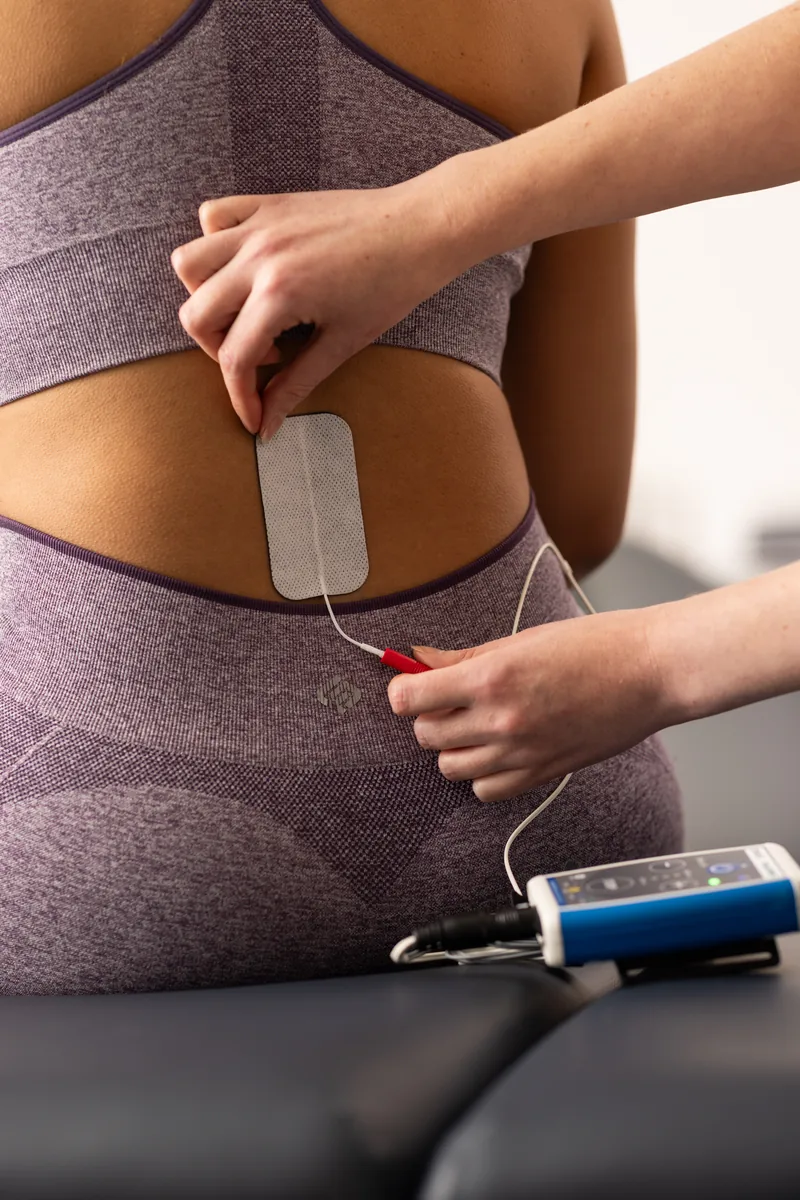
The procedural knowledge for tSCS calibration is genuinely new for most RehaMove-only clinicians. The standard pathway involves identifying the posterior root muscle reflex threshold using 1 Hz biphasic 1-millisecond pulses, then setting the working tSCS current to 90% of that value. This is a small protocol to learn, but it is not a translation of anything you did on the RehaMove. If you want to add tSCS to your service, this is one of the parts you genuinely train into.
Methods of Triggering
Our Stim2Go programmes are organised by three key classification criteria. The Primary Function indicates the therapeutic purpose, such as FES or FES Cycling for movement assistance, TENS for pain relief, NMES for muscle strengthening, or tSCS for spasticity or pain reduction.
Just as the RehaMove system allowed sequences of stimulation to be triggered, Stim2Go has taken this to a new level. The Stim2Go unit has built-in motion sensors, which are key to greatly improved functionality and flexibility of application.
Trigger Modes include Auto Repeat for continuous delivery of a stimulation sequence, Motion Triggered options synchronised with movements, and Manual Triggered for user-initiated activation. Channel Configurations range from single-channel (1CH) to five-channel (5CH) programmes, depending on complexity.
The motion-derived phase detection works well. In FES Cycling it tracks leg movement (or arm movement for arm cranking) reliably enough to drive stimulation in time with the leg movement. Whether it achieves equivalent timing accuracy to cable-coupled pedal-position telemetry in users with high spasticity, asymmetric pedalling, or severe deconditioning remains an open question, as no peer-reviewed publication addresses it. However, as with the RehaMove system, it is possible to easily adjust the stimulation phasing during cycling.
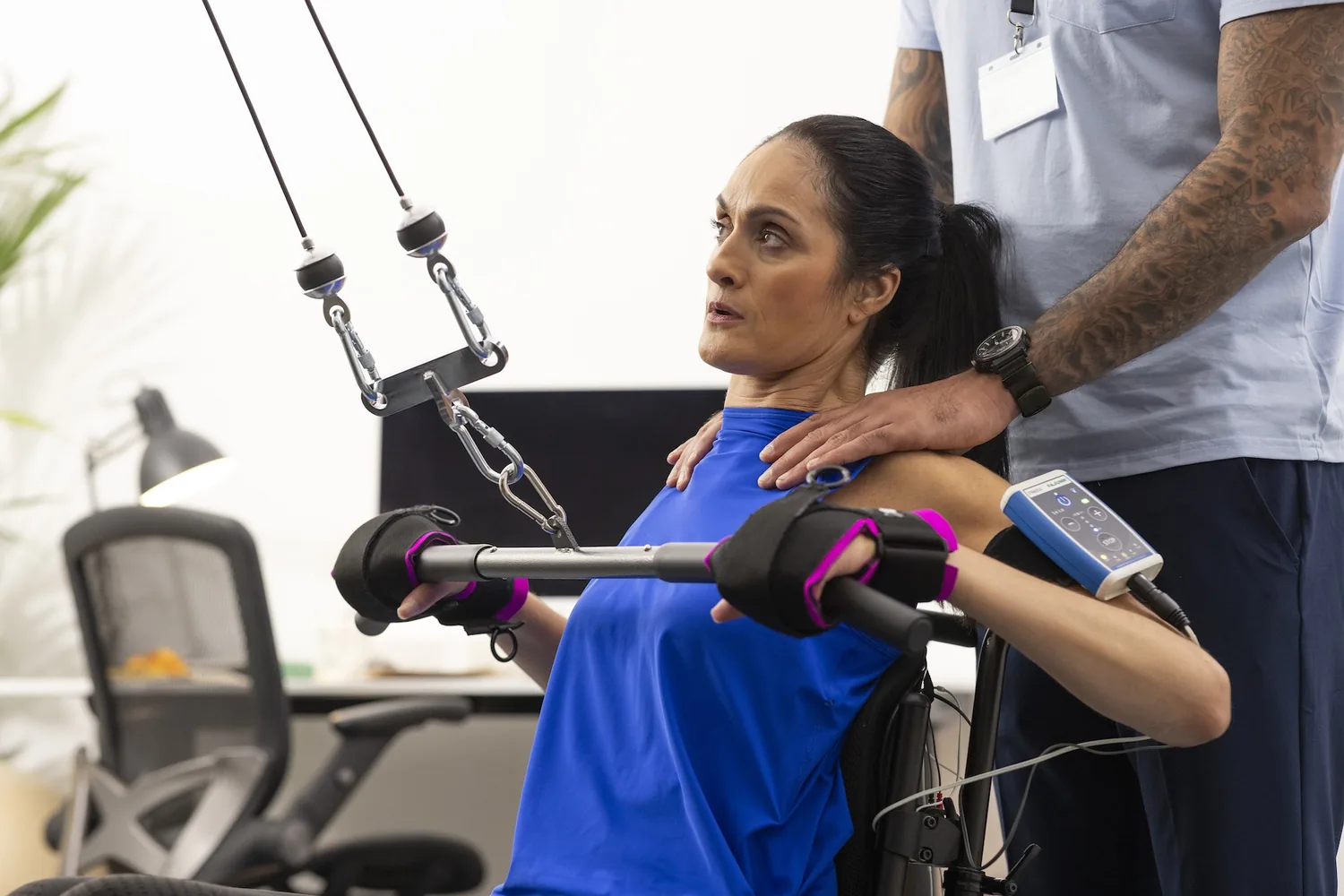
We like that you can set motion/angle thresholds to trigger stimulation. This is particularly useful for upper-limb exercises, such as reaching or sit-to-stand, when the individual has some functional movement that you wish to assist.
The body of evidence on Stim2Go-specific cycling outcomes, as I write this in May 2026, is of course, relatively thin. The published clinical evidence for FES cycling benefits, muscle preservation, cardiovascular conditioning, bone density signals, spasticity reduction, and secondary health benefits is still relevant, though. None of those benefits is mechanism-specific in a way that should fail to translate.
The summary is this: the FES cycling evidence is solid and translates to the new device. The Stim2Go-specific outcome literature is still being built. The peer-reviewed work to date from the underlying SensorStim Neurotechnology team has been on the platform's sensing methods, including a 2025 randomised crossover trial of tSCS in progressive multiple sclerosis and 2024 work on mechanomyography-based tSCS targeting, rather than long-term FES cycling outcomes.
Practical Implications for Your Service
If you are running an existing RehaMove service and thinking about the transition, three practical points.
First, your MOTOmed or Thera-Trainer estate are not redundant. Stim2Go pairs with most active-passive cycle ergometers because it does not depend on bike-side telemetry. Replacing a stimulator does not have to mean replacing a bike.
Second, the per-unit price point has moved. The Stim2Go, paired with a Thera-Trainer as a complete new system, is very competitively priced and less than the equivalent RehaMove. For clinics, this shifts the conversation from replacing capacity to adding it.
Third, the learning curve is real but short. Onboarding for our clients runs to about 90 minutes of structured setup at the location, plus a 6-week follow-up visit. For an experienced therapist taking on the device, the genuinely new procedural knowledge is the IMU set-up for cycle phase, the app-based workflow, and, if you are adding it, the tSCS calibration pathway. Each of those is hours of practice, not weeks of retraining.
Where to Go From Here
If you are a physio or clinic owner sitting on a working RehaMove with another year or two of life left in it, you do not need to act urgently. Hasomed's withdrawal from the European market does not switch off existing units. But the question of consumables, electrodes and longer-term support is one you should be asking now rather than later.
If you are considering a new programme or replacing a unit that has reached the end of its life, the architectural and clinical case for Stim2Go is straightforward. It does most of what the RehaMove did, decouples the stimulator from the bike, brings tSCS onto the same device, and works through an app-based interface that most clinicians find easier to navigate than a console after a fortnight.
If you would like to talk through how a transition would look in your service, or simply to see the device in the clinic before forming an opinion, please get in touch.
Further Reading
- Pajunk Stim2Go product page. https://pajunk.com/products/neurology-neurorehabilitation/fes-nmes-tens/stim2go/
- US FDA 510(k) clearance K230701 for the Pajunk Stim2Go, decision 24 November 2023. https://www.accessdata.fda.gov/scripts/cdrh/cfdocs/cfpmn/pmn.cfm?ID=K230701
- van der Scheer JW, Goosey-Tolfrey VL, Valentino SE, et al. Functional electrical stimulation cycling exercise after spinal cord injury: a systematic review of health and fitness-related outcomes. Journal of NeuroEngineering and Rehabilitation 2021. https://link.springer.com/article/10.1186/s12984-021-00882-8
- Spieker EL, Hoffmann M, Otto C, et al. Short-term effect of transcutaneous spinal cord stimulation in patients with multiple sclerosis: a randomised sham-controlled crossover study. Frontiers in Neurology 2025;16:1618519. https://doi.org/10.3389/fneur.2025.1618519
- Anatomical Concepts (UK). Stim2Go and Support for Transcutaneous Spinal Cord Stimulation. 10 October 2025. https://www.anatomicalconcepts.com/articles/stim2go-and-support-for-transcutaneous-spinal-cord-stimulation