In a good proportion of lower-limb neurorehabilitation, the factor limiting functional progress is not insufficient force. It is spasticity. The patient has enough residual capacity to attempt a sit-to-stand, but extensor tone resists the movement, a spasm disrupts the timing, or clonus prevents a stable foot position. When spasticity is the rate-limiting step, adding more strengthening work does not address the bottleneck. Sequencing does.
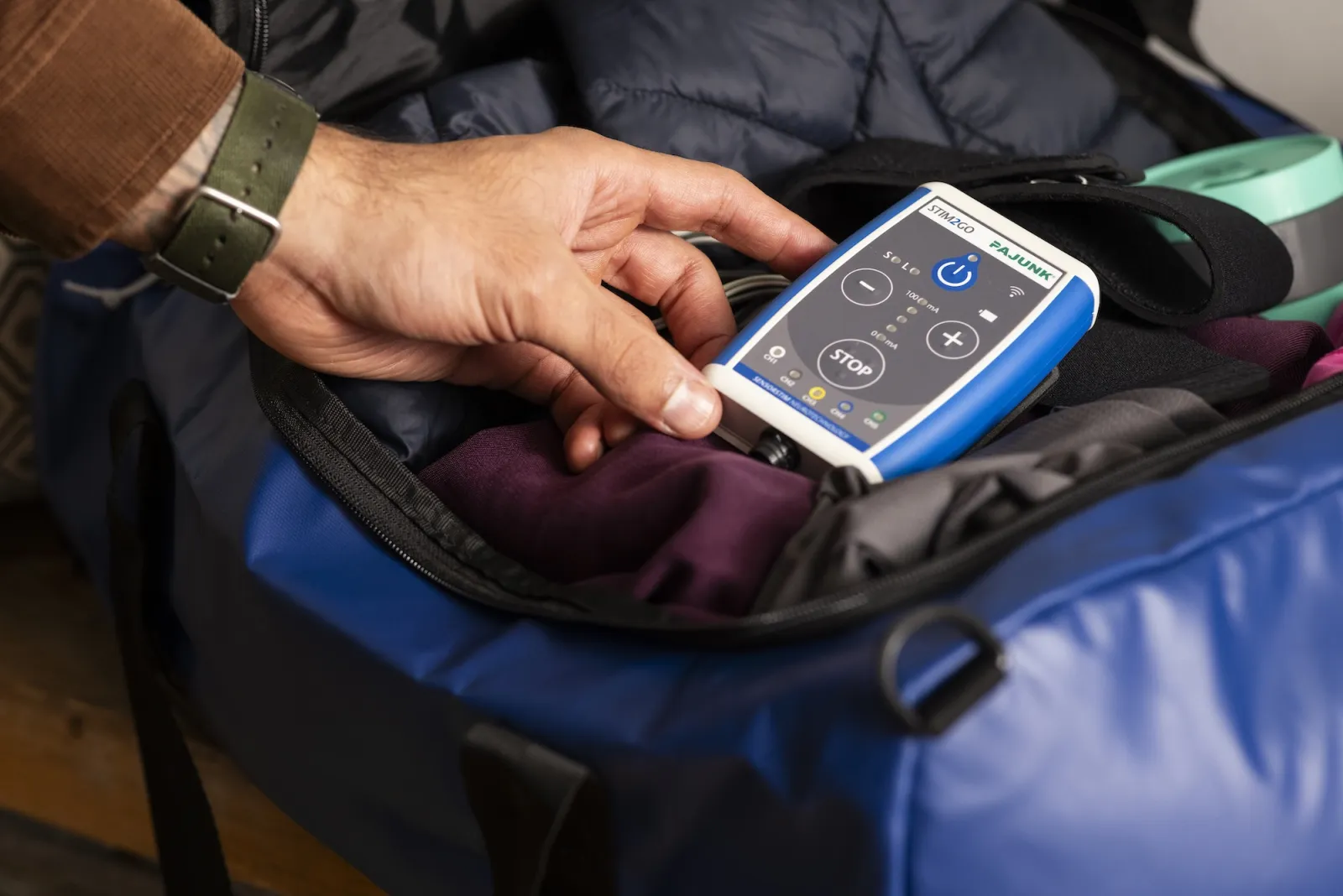
This article makes the case for a specific order of operations: reduce the spasticity first, then practise the functional task while the window is open. It is the clinical companion to the sit-to-stand piece, and it relies on the same device, the Stim2Go, because that device carries both halves of the sequence in a single unit.
Why Spasticity Specifically Obstructs Sit-to-Stand
Sit-to-stand is a useful test case because it exposes several spasticity-related problems at once. The rise requires a controlled forward lean against extensor tone, a coordinated knee-extensor and hip-extensor drive that spasm timing can disrupt, and a stable base of support that clonus undermines. A patient who could generate adequate force in isolation can still fail the integrated task because the spasticity desynchronises it.
It is worth stating the obvious caveat, because it changes practice: not all tone is unwanted. Some patients recruit extensor tone functionally for standing and transfers, and the clinical aim is to reduce the spasticity that interferes rather than to abolish tone wholesale. The target is the problematic component, defined against the patient's own functional goals.
Where Spasticity Comes From
It helps to be clear about what is actually being treated. Spasticity is one feature of the upper motor neurone syndrome, the cluster of changes that follows damage to the central nervous system, whether from spinal cord injury, stroke, multiple sclerosis, cerebral palsy or traumatic brain injury. The common thread is the loss of the descending control that normally keeps spinal reflex circuits in check.
Under normal conditions, pathways descending from the brain and brainstem provide a steady background of inhibition to the reflex networks in the spinal cord. When a lesion interrupts those pathways, that inhibition is reduced or lost, and the circuits below the level of injury become hyperexcitable. Stretch reflexes become exaggerated and velocity-dependent, presynaptic and reciprocal inhibition weaken, and post-activation depression is reduced. The result is the familiar picture of involuntary stiffness, brisk tendon jerks, clonus, and flexor or extensor spasms.
This does not appear overnight. After a spinal cord injury, the early phase is often one of spinal shock, with flaccidity and absent reflexes. Over the following weeks and months, the reflex circuits reorganise, and spasticity emerges and evolves, usually stabilising in the chronic phase while remaining modifiable. We set out that time course in more detail in our article on spasticity after spinal cord injury.
One practical point matters as much as the neurophysiology: spasticity is rarely constant. It fluctuates, and it is easily provoked. A urinary tract infection, a pressure injury, a loaded bladder or bowel, an ingrown toenail, or any other source of noxious input below the lesion can drive a marked, sometimes sudden, increase in tone. When spasticity worsens, the first move is to look for and treat the aggravating cause rather than reach straight for a higher drug dose or a stimulator.
Management then follows a stepped, individualised path, and electrical stimulation is one part of a wider toolkit. Once the aggravating factors are addressed, the mainstays are physical: regular stretching, careful positioning, standing, splinting where appropriate, and active exercise, with FES cycling itself contributing a reasonable anti-spastic effect over a programme. Medication has its place, from oral agents such as baclofen and tizanidine to focal botulinum toxin and, in severe cases, intrathecal baclofen, although sedation and unwanted weakness are common reasons patients seek alternatives. Neuromodulation, and transcutaneous spinal cord stimulation in particular, is the newer entry, and it is the route this article focuses on: used not as a replacement for the rest, but as a way to open a window for productive functional practice.
Two Mechanisms, Used in Order
Electrical stimulation acts on spasticity through multiple routes, and the practical value lies in deliberately combining them.
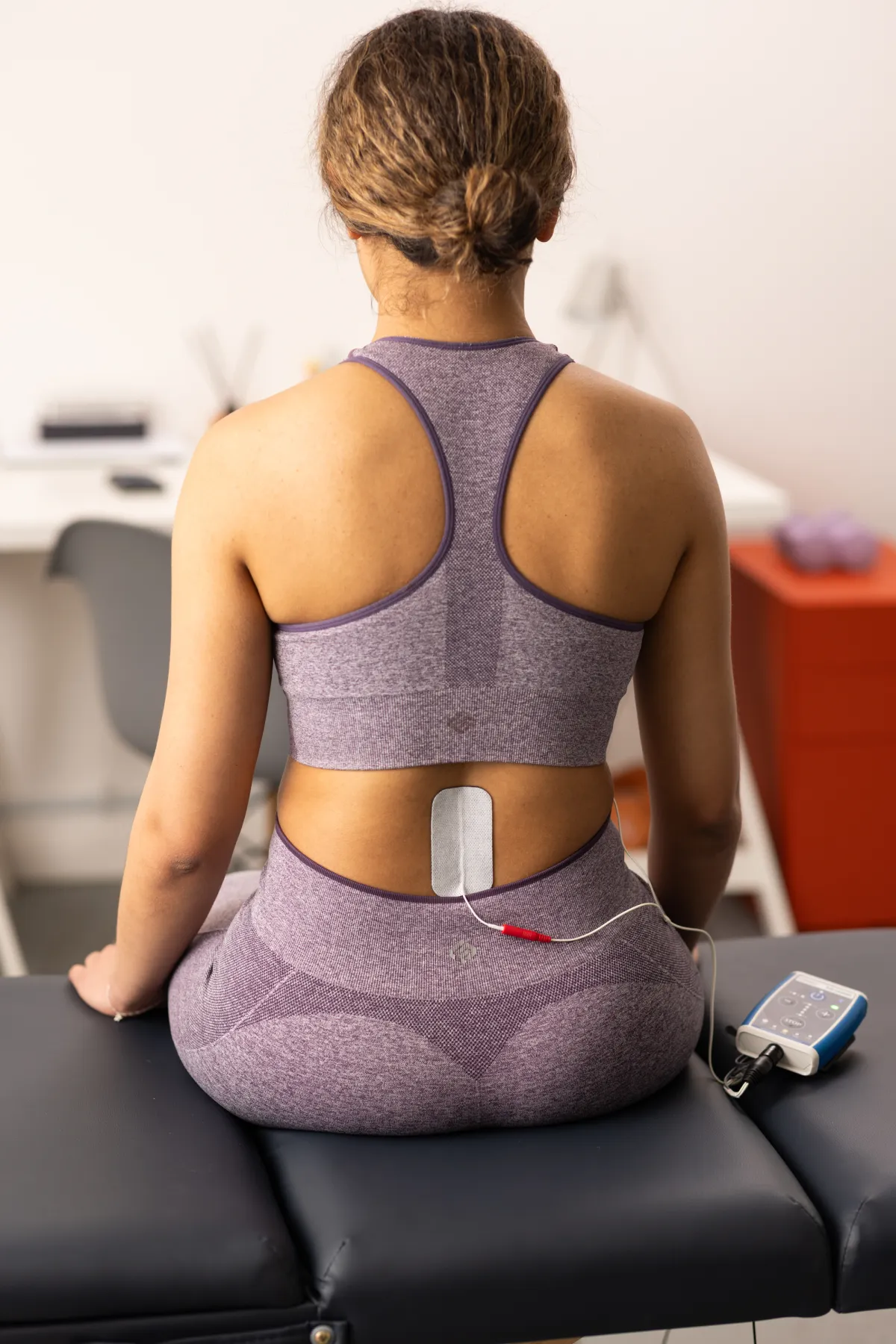
tSCS as the priming step. Transcutaneous spinal cord stimulation modulates spinal circuit excitability via dorsal root afferents and has a reasonable and growing evidence base for spasticity reduction. Used ahead of functional work, the logic is to reduce involuntary resistance and open a window during which task practice is more productive. The calibration pathway is the one set out in the transition article: identify the posterior root muscle reflex threshold, then set the working current at around 90 percent of it. Stim2Go has a specific tSCS priming programme for this purpose. With the user in a lying or standing position, one electrode is placed over T11/T12 and two electrodes on the abdomen. The stimulation frequency is 1 Hz and the pulse width is 1 ms with biphasic rectangular pulses.
FES and NMES as both treatment and practice. Functional electrical stimulation has well-established anti-spastic effects accumulated over a programme, attributed to mechanisms including restored post-activation depression, enhanced reciprocal and recurrent inhibition, and spasm reduction through repeated rhythmic activation. So the assisted sit-to-stand practice that follows the priming step is not neutral with respect to spasticity; it contributes to the same goal while it builds the task.
The Sequence in a Session
A workable structure looks like this, always inside a proper assessment rather than as a recipe:
- tSCS Prime. A block of tSCS at the calibrated sub-motor or motor-adjacent current appropriate to the goal, long enough to produce a usable reduction in tone; typically 20 minutes.
- Practise. Move to triggered NMES sit-to-stand, beginning in Manual Triggered mode and progressing to Motion Triggered as the patient's movement allows, with stimulation topping up the knee and hip extensors in time with the volitional attempt. Stim2Go is placed on the right thigh or potentially the trunk.
- Progress. Fade the stimulation contribution and the assistance over sessions as volitional control improves and as the spasticity response, which often improves cumulatively across a programme, allows.
Because the Stim2Go delivers both tSCS and triggered NMES through one body-worn unit and one app, the priming step and the practice step are a change of programme, not a change of equipment in the middle of a session. That lowers the friction of actually running the sequence, which is often what determines whether it gets done.
Limits and Cautions
The boundaries are as follows:
- The FES anti-spasticity evidence is solid and programme-length; the tSCS evidence for spasticity is promising and still maturing, with meaningful individual variation in response. The priming effect can be very significant, but will vary between individuals.
- Spasticity is modifiable but persistent. This is management in service of function, not eradication, and the cumulative programme effect matters more than any single session. Using tSCS we would expect an initial positive change, but with repeated use the carry-over effect is the real bonus.
- Autonomic dysreflexia risk in susceptible patients is a genuine precaution with both spinal stimulation and vigorous functional work. Screening and monitoring are part of the protocol, not an afterthought.
- Standard contraindications for surface stimulation apply, and the assessment exists to identify the patient for whom tone is functionally useful and should not be suppressed.
Summary
When spasticity is the rate-limiting step, the productive move is not more strengthening but better sequencing: first of all "prime" with tSCS to reduce the interfering tone, then practise the functional task with triggered NMES while the window is open, and let the FES contribution work on the spasticity cumulatively across the programme. Sit-to-stand is the natural first task to apply this to, and the Stim2Go carries both halves of the sequence on one unit, which is what makes it realistic to run session after session.
If you would like to see the priming-then-practice sequence set up, or to talk through the patients in your caseload for whom spasticity is the obstacle rather than weakness, please get in touch.
Further Reading
- Pajunk Stim2Go product page. https://pajunk.com/products/neurology-neurorehabilitation/fes-nmes-tens/stim2go/
- Anatomical Concepts (UK). Stim2Go and Support for Transcutaneous Spinal Cord Stimulation. 10 October 2025. https://www.anatomicalconcepts.com/articles/stim2go-and-support-for-transcutaneous-spinal-cord-stimulation
- Anatomical Concepts (UK). Spasticity After Spinal Cord Injury: When Medication Isn't the Answer. 22 January 2026. https://www.anatomicalconcepts.com/articles/spasticity-after-spinal-cord-injury-when-medication-isnt-the-answer
- Anatomical Concepts (UK). The Stim2go Transition for RehaMove-Trained Physiotherapists. May 2026. https://fescycling.com/blog/the-stim2go-transition-for-rehamove-trained-physiotherapists
- Spieker EL, Hoffmann M, Otto C, et al. Short-term effect of transcutaneous spinal cord stimulation in patients with multiple sclerosis: a randomised sham-controlled crossover study. Frontiers in Neurology 2025;16:1618519. https://doi.org/10.3389/fneur.2025.1618519