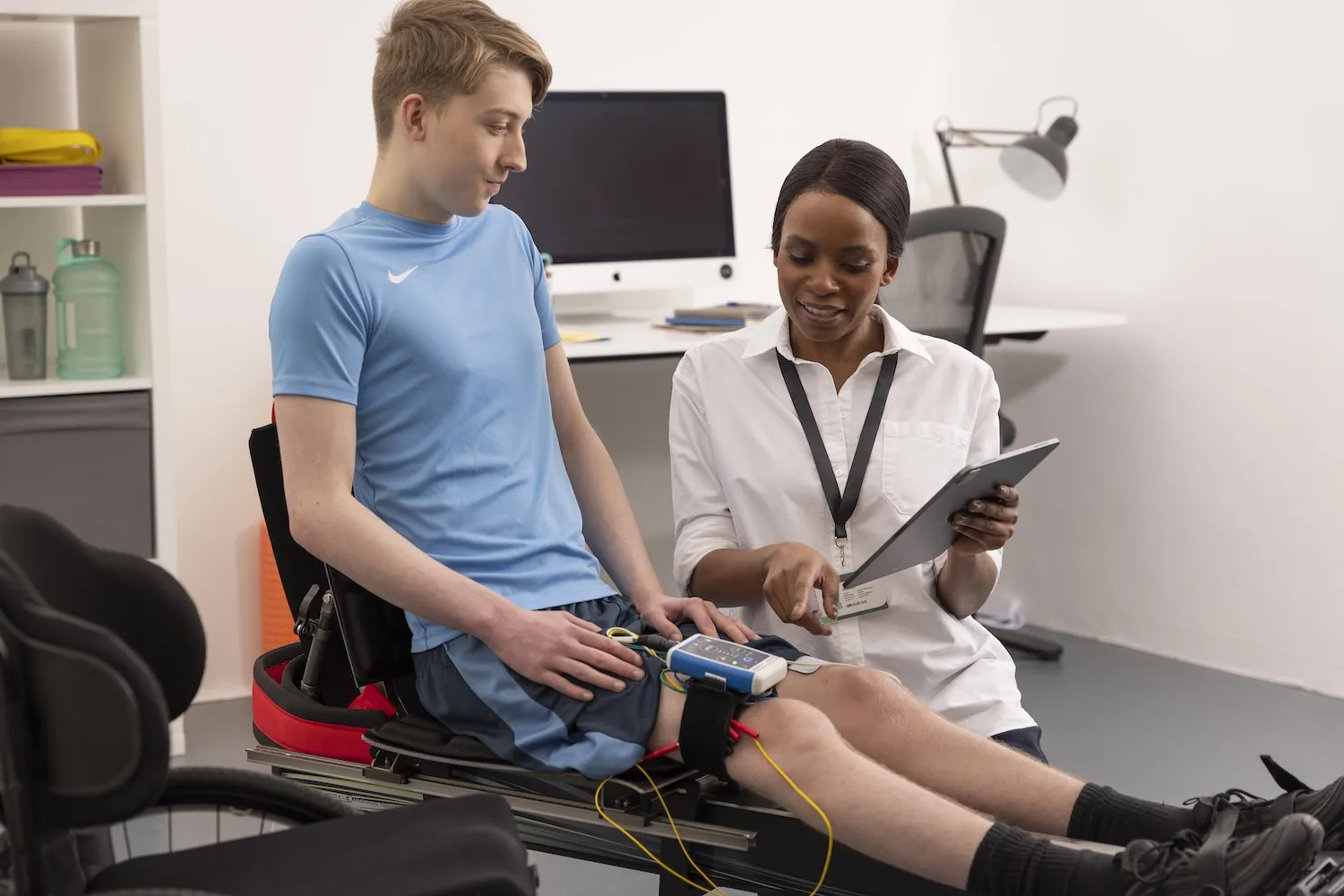
Most clinicians first meet the Stim2Go as the stimulator at the heart of an FES cycling system. Actually, the FES Cycling capability was the key quality that interested us in representing the product in the first place. This is a very reasonable position to hold, but it undersells the device. The same body-worn unit, with the same motion sensing that drives cycle-phase detection, is well suited to triggered neuromuscular electrical stimulation (NMES) for functional task practice. Sit-to-stand is the obvious place to start because it is clinically important, most of your patients already work on it, and it maps cleanly onto what the device does well.
This article is the practical counterpart to the piece I wrote on the RehaMove to Stim2go transition. There I set out what carries across, what needs recalibrating, and what is genuinely new. Here I want to take one widely used application, sit-to-stand, and walk through how to think about it and how to set it up.
Why Sit-to-Stand Is Worth the Attention
Sit-to-stand is one of the highest-value movements in neurorehabilitation. It is a prerequisite for independent transfers, underpins standing tolerance, and is biomechanically demanding, making it a genuine training stimulus rather than a token exercise. The concentric rising phase requires a coordinated, rapidly developed contraction of the knee and hip extensors, with the calf and trunk contributing to stability and balance.
After spinal cord injury or stroke, the limiting factors are familiar: insufficient force from the quadriceps and gluteals, poor timing or delayed recruitment, and in many cases, spasticity that interferes with positioning and initiation. NMES addresses the first two directly, by adding recruited force at the moment of need, and the device's tSCS capability gives you a route at the third.
The Case for Triggered, Rather Than Cyclic, Stimulation
The clinical argument for the Stim2Go in this setting rests on one feature: it can wait for the patient. Open-loop NMES on a fixed timer is fine for strengthening, but it is poorly matched to a volitional functional task, where the assistance needs to coincide with the patient's own attempt to rise.
The Stim2Go offers three trigger modes that matter here:
- Manual Triggered, where the therapist or patient initiates the stimulation sequence at the start of the rise. This is the most robust starting point and the one I would default to for early sessions. The therapist acts by touching a "key" in the Stim2Go app.
- Motion Triggered, where the unit's accelerometer and gyroscope detect the movement, or a set angle or threshold, and fire the stimulation sequence. This is the mode that turns the task into a closed loop of intention and assistance, and it is the one to progress toward where the patient has usable residual movement to sense. For example, Stim2Go can be attached to the trunk of the user and the stimulation sequence is triggered by the forward movement of the trunk.
- Auto Repeat is less relevant for sit-to-stand itself, but it is useful for the preparatory strengthening work that often precedes it. In this mode, the stimulation sequence is defined by time, and once triggered, it repeats for a training period that typically lasts several minutes.
The reason to care about the distinction is not only timing comfort. A volitional attempt, paired with well-timed afferent and proprioceptive feedback from a completed movement, is exactly the kind of active, task-specific practice that the motor relearning literature supports. Cyclic stimulation gives you contractions. Triggered stimulation gives you repetitions of the actual task.
Setting It Up
What follows is an orientation, not a substitute for hands-on training. Electrode placement, dosing, and progression should always sit inside a proper assessment.
Channels and placement. A practical sit-to-stand configuration uses the quadriceps bilaterally as the primary movers, with the gluteals added where you have the channels and the need. The Stim2Go supports single-channel through to five-channel (1CH to 5CH) programmes, so a two-channel bilateral quadriceps setup is the simplest starting point, and can be expanded to include gluteals. Placement follows standard NMES motor-point principles; nothing here departs from what you already know.
Parameters. The recruitment physiology is unchanged from any surface NMES you have run. You are setting frequency, pulse width, and current to produce a strong, fused, tolerable contraction, with a ramp that feels natural at the point of rising rather than abrupt. Build current to the functional requirement over sessions rather than chasing maximal output on day one.
Triggering. Begin in Manual Triggered mode so that you control the timing while the patient learns the movement and you learn their response. Progress to Motion Triggered, setting the motion or angle threshold so the sequence fires as the patient initiates forward lean and rise. The body-worn unit is typically strapped to the thigh in the same position used for cycle-phase detection, keeping the sensor close to the segment that moves first. Alternatively, the Stim2Go can be attached to the trunk and the stimulation sequence triggered by forward leaning of the trunk.
Session structure. Treat it like any task practice: a warm-up and sub-maximal familiarisation, a working block of assisted repetitions with adequate rest, and progression by reducing assistance, increasing repetitions, or moving from a higher seat to a lower one as the patient improves. The goal over time is to fade the contribution of stimulation as volitional capacity grows.
With the Stim2Go app, the process of creating a suitable programme goes like this.
- Review the many "template" programmes and choose one which is closest to the required functionality.
- Create a new custom programme by copying your selected template and name it "Sit to Stand".
- Check the channel assignments and activate Channel 5 if using tSCS.
- Select the training parameters: set the total session duration, the stimulation sequence duration, and the sequence mode to be manually triggered or motion triggered as required for the client.
- Use the phase editor to control the stimulation sequence timing for each muscle.
- Check the frequency and pulse width settings.
All of this can be accomplished within the Stim2Go app.
Where tSCS Fits
For patients in whom spasticity is the rate-limiting factor, the device's transcutaneous spinal cord stimulation capability offers something the RehaMove did not provide for the same unit. Used as a priming step before functional practice, tSCS has an evidence base for spasticity reduction, and the practical logic is straightforward: reduce the involuntary resistance first, then practise the task while the window is open. The calibration pathway is the one I described in the transition article, identifying the posterior root muscle reflex threshold and working at around 90 percent of it. If you are adding tSCS to your service, this is genuinely new procedural knowledge rather than a translation of anything from the RehaMove.
Can you expect any functional recovery by using tSCS? This is something that is subject to research at the moment.
Limits and Open Questions
I would rather set expectations clearly than oversell a setup I like.
- Motion-triggered performance depends on the patient having sufficient, repeatable residual movement for the sensors to detect. With very low volitional movement, manual triggering remains the sensible choice.
- The general principle of NMES-assisted and FES-assisted sit-to-stand is well represented in the rehabilitation literature across stroke and SCI populations. Outcome data specific to Stim2Go for this application is limited, as is the case for most newer devices. The peer-reviewed work from the underlying SensorStim Neurotechnology team to date has centred on sensing methods and tSCS rather than functional task outcomes.
- This is assisted practice within a programme, not a stand-alone intervention. It complements, rather than replaces, the therapist's handling, the strengthening work, and the balance training around it.
- Standard NMES contraindications and precautions apply, and screening is part of the assessment, not an afterthought.
Summary
The Stim2Go earns its place as an FES cycling stimulator, but treating it as a cycling device alone leaves capability on the table. The same unit, the same sensors, and the same app give you a credible tool for triggered functional task practice, and sit-to-stand is the natural first application: clinically important, biomechanically suited to quadriceps and gluteal NMES, and a good fit for motion-triggered assistance that arrives in time with the patient's own effort. Add tSCS for the spasticity-limited patient, and a single device covers a useful span of a lower-limb programme.
If you would like to see the device set up for functional task work rather than cycling, or to talk through how it would fit your caseload, please get in touch.
Further Reading
- Pajunk Stim2Go product page. https://pajunk.com/products/neurology-neurorehabilitation/fes-nmes-tens/stim2go/
- US FDA 510(k) clearance K230701 for the Pajunk Stim2Go, decision 24 November 2023. https://www.accessdata.fda.gov/scripts/cdrh/cfdocs/cfpmn/pmn.cfm?ID=K230701
- Anatomical Concepts (UK). The Stim2go Transition for RehaMove-Trained Physiotherapists. May 2026. https://fescycling.com/blog/the-stim2go-transition-for-rehamove-trained-physiotherapists
- Anatomical Concepts (UK). Stim2Go and Support for Transcutaneous Spinal Cord Stimulation. 10 October 2025. https://www.anatomicalconcepts.com/articles/stim2go-and-support-for-transcutaneous-spinal-cord-stimulation